What Is Adsense ?
Adsense is a Product of Google. If You are a blogger,Youtuber or a App developer . You Must need a Adsense Account.

The name was adopted by Google after Google acquired Applied Semantics in April 2003. .In February 2010, GoogleAdSense started using search history in contextual matching to offer more relevant ads. On January 21, 2014, Google AdSense launched Direct Campaigns, a tool where publishers may directly sell ads.

What is the history of Google AdSense?
- Google launched search-targeted contextual ads, called AdWords. Not directly connected to AdSense, but worth mentioning, and USA Today falsely dates this to 2002. (Announcement: October 23, 2000)
- Applied Semantics announces their service called AdSense. (Announcement: October 21, 2002, with launch in November)
- At around the same time, Google launched their contextual targeting ads into an early test phase for some limited sites. This of course means it had already been thought of and in building state (at least) earlier that year. (“Fourth quarter”
20032002, Traffick.com) - Google goes fully live with their contextual ads technology. (Announcement: March 4, 2003)
- Shortly later, Google acquires Applied Semantics, and their contextual ads product AdSense, to (according to Google) complement their “content targeted advertising programs.” (Announcement: April 23, 2003)
- Google then renamed their context ads program to AdSense (and probably incorporated a little, or a lot, of the Applied Semantics technology into their existing ads system). (Announcement: June 18, 2003.)
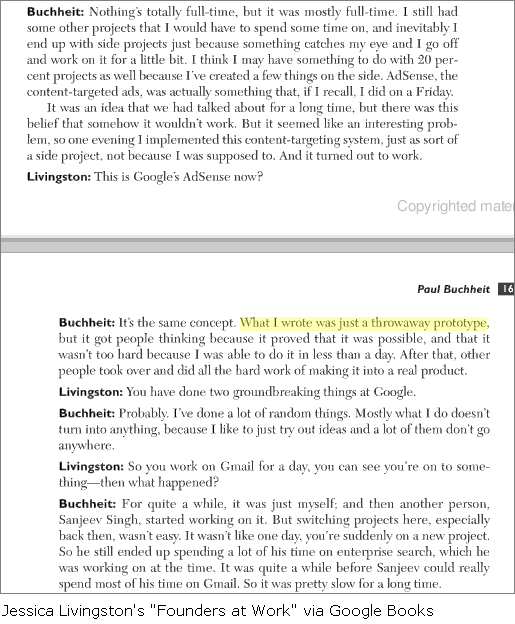
To wrap up: yes, the idea was apparently in the air around 2002, perhaps Applied Semantics came up with it first, perhaps Google, perhaps someone entirely different. (Ex-Googler Paul Buchheit in the book Founders at Work claims the idea was talked about at Google for a long time, before he actually wrote a throwaway prototype in a single day, which got things moving.) And probably, Google at the time tried to sell their product as if it was the only of its kind around; e.g. Susan told CNet in 2003, “Small sites ... didn’t have a way to reach advertisers." And if Google didcopy the idea – which I don’t know, and they weren’t available for a statement yesterday – then Susan’s statements like “People were saying, ’This is a sports site, so we’ll serve a sports ad.’ And we were saying, ’No. We can actually look at the page in real time and figure out what this page is about.’” would be somewhat misleading... but Valleywag doesn’t show any proof Google copied the concept and only points to the USA Today article.
What Valleywag does say is that Susan in the USA Today article claims to have invented “AdSense,” even when in it she only says she introduced the then still novel idea of webpage-contextual ads to Google – it’s the USA Today author who refers to it as AdSense continuously instead of saying e.g. “the product that was later called AdSense.”

Quick Tips For Earn Money Via Adsense
If you are just starting out, there are several things that you should absolutely do in order to get the most out of AdSense. The official guides offered during the signup process are fairly limited, not offering any particularly noteworthy advice. You may already be implementing many of these, but there are likely some pieces of low hanging fruit among the following.
- Max Out Ad Units. We’ll start off with an easy one: AdSense lets you have up to three standard ad units on a page, so you’d be wise to take advantage by maxing out.
- Max Out Link Units. Link units are a wildly underused AdSense option; placing up to three of these on a page should give you a quick, meaningful boost. For sample implementations of link units, check out these example pages.
- Pay Attention to Link Units. This point is worth reiterating. While many publishers focus primarily on traditional ad units, link units have the potential to out-earn leaderboards and rectangles.
- Set up a Custom Search Engine. This is another way to get more AdSense units on your site; custom search engines will generally see very high RPMs (though traffic is relatively light).
- Enable Placement Targeting. This allows advertisers to include your website in their campaign, either by name or by targeting an interest group. Placement targeting should be enabled by default, but if you’re using DFP you may need to take a few additional steps.
- Set up Custom Channels. Setting up custom channels will allow you to get better insights into what’s working and what isn’t, and will make testing down the road easier. It’s pretty easy to get these up and running, and worth making the up front investment to do so.
- Allow Text & Images. One of the primary choices within AdSense involves either restricting an ad unit to “image only” or allowing both text and image ads. Permitting text ads to show gives AdSense a deeper pool of ads, and will almost certainly increase your click rate and earnings.
- Use Standard Units. While AdSense lets partners choose from more than a dozen ad units, there are a few units that are more common with advertisers. Using these common ad sizes–300×250, 728×90, and 160×600–will give AdSense a deeper pool of advertisers from which to choose.
- Monitor Fill Rate. Make sure that you’re serving ads and not blank space on your site. Monitoring fill rate is an easy way to do this; if there are any discrepancies, here are five reasons why AdSense and Analytics may not match.
- Supplement AdSense. The terms and conditions of AdSense allow for only three ad units per page. In many cases, pages can comfortably accommodate more than three ads per page without overwhelming visitors and leading to a bad experience. If you think your site could use more ad units, there’s nothing to stop you from supplementing your AdSense units with ads from a competing provider. (For more on supplementing AdSense with additional ad networks, jump to this section.)
- Place Units Above the Fold (ATF). This one might seem obvious: the higher up on a page your ads are, the more they’ll be viewed (and the more you’ll earn).
- Relative Positioning Matters. While placing ads above the fold is generally advantageous, the relative positioning of ads (i.e., what they’re next to) is more important than their explicit location in the page. Scroll down to #24 on this list for an example of an ad that’s above the fold, but likely out of sight within the first few seconds of a visitor being on the page.
- Beware of Overdoing It. When chasing AdSense earnings, it’s easy to get carried away and make decisions that are detrimental to the user experience in order to generate some additional revenue. While there may be a short term win, you’ll ultimately hurt the long term earnings potential of your siteby eroding your traffic base. Here is the example Google gives of what not to do (on the far right):


No comments:
Post a Comment
Please Enter Comment Related To This Blog !